Sunday, June 9, 2013

Filling Buckets


I think maybe every Peace Corps Volunteer goes through doubt, wondering if they can actually make a difference in their community. Those doubts have certainly been through my mind. When the changes you are trying to make are basically intangible, it’s even more difficult. But the good news is that every once in a while I get a nice pick-me-up. Usually it’s something small, an encouraging word from somebody. That’s what we call filling someone’s bucket.

For example the other day I was sitting in Linito’s house talking about how many different ways there are to cook plantains. As it turns out there are about seven or eight different ways: boiled, fried, grilled, mashed, double fried… Anyway the conversation turned to how much longer I would be living here, and he asked me what happens when I leave. I told him that if the community requests another volunteer from Peace Corps then somebody else will come to take my place. Linito thought about that and said, “But how could anyone replace Benjamín? What if we make a special request to your boss and ask that you stay for another two years?” I told him, “Okay, we’ll see what the boss says.” What I love about people here is how they are so accepting regardless of my perceived productivity or my value to the community. Since I’m mainly working with a small group, most people never actually see me working behind the scenes. And yet they still think it’s great that I’m here.

A different day I was talking with a few guys at Joel’s house over some plantain soup. We talked about Spanish gold hidden in the Darien and how I should quit Peace Corps and just become a gold hunter. They asked me what people back in the States thought about me living in the middle of nowhere in the jungle. I said people probably think I’m a little crazy. Now Leonurcio is a somewhat awkward guy, and very shy, especially for an Emberá. So it was unexpected when he spoke up and said to me, “You know people might think you’re crazy, but the Bible says that everyone thought the prophets were crazy too. You are working here in this community for a reason. God has a purpose for you.” I literally just sat there staring at him with my mouth half open; I didn’t know what to say. It seems that God speaks through unlikely people in unlikely places.
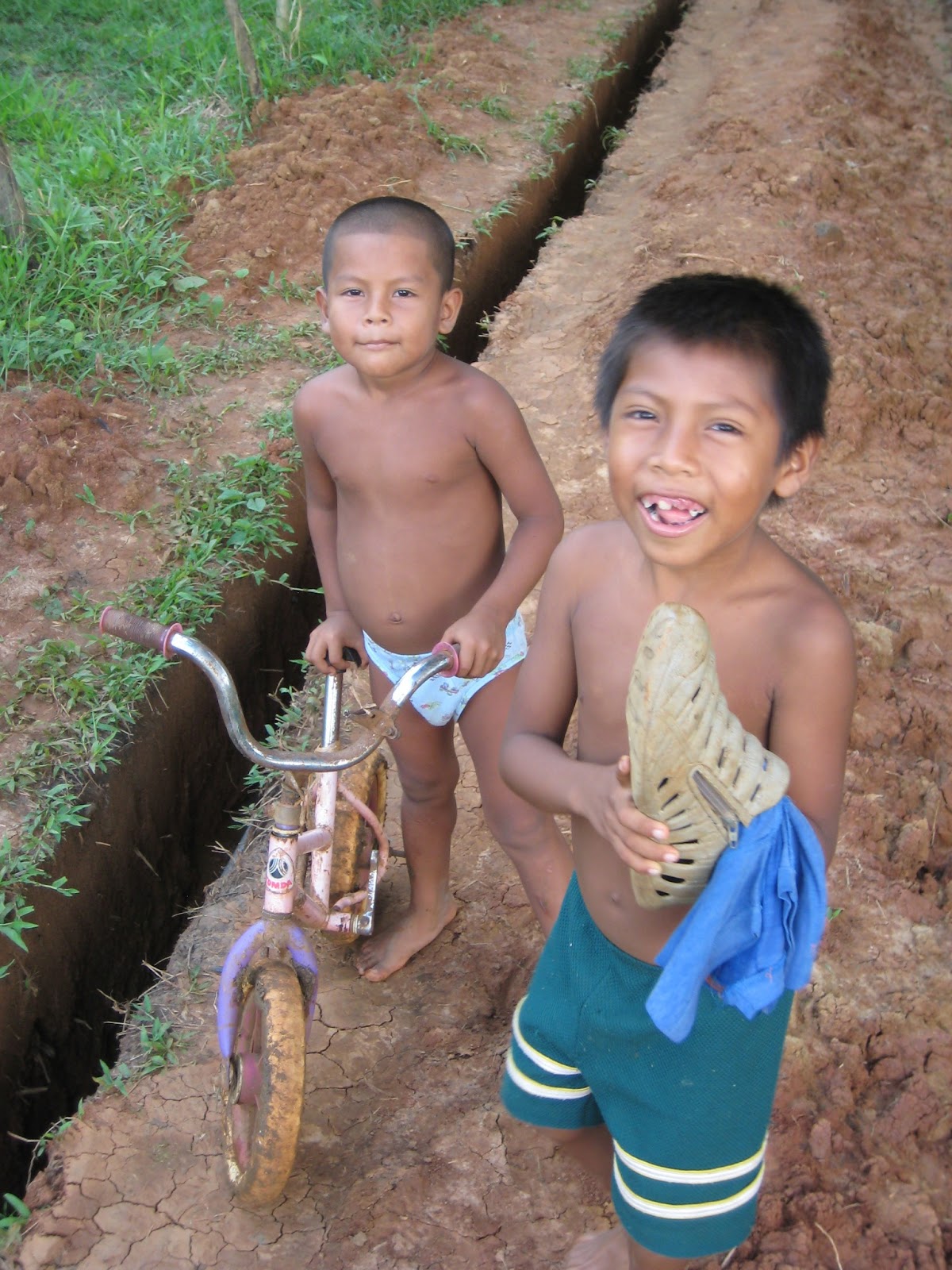
This kid's filling his bucket, a very small bathtub

Thursday, May 2, 2013

One Year in Panama


As of today I have been living in Panama for a whole year. On May 2, 2012 I stepped off a plane into a blast of hot and humid air, wondering what I had gotten myself into. Oh, how far I’ve come since then. Let’s take a moment to look back on a few of the lessons (or just random facts) I’ve learned about Panamanian life as a Peace Corps Volunteer in the past year:

1.       There are only three times each day: hot o’clock, lunch o’clock, and dark o’clock.
2.       The rainy season changes everything.
I spend a lot of time watching chickens
3.       A plastic bag of frozen sugar juice is always worth the ten cents.
4.       Ahora means anything but “right now.”
5.       Fried plantains go with everything.
6.       A coconut falling on your head is a legitimate danger.
7.       Never bathe in the river at night.
8.       Endangered animals are delicious.
9.       Always keep your machete sharp.
10.   Just pretend you know what you’re doing.
11.   Roosters are the most terribly annoying creatures on the planet.
12.   Don’t worry, it always works out somehow.
13.   The bus will get there when it gets there. If it gets there.
14.   Kids are experts at getting fruit out of trees.
15.   Palm branch roofs are extremely flammable.
16.   English is a really bizarre language.
17.   Your mosquito net is a night time force field.
18.   The jungle will swallow anything if you leave it long enough.
19.   Build people, not monuments.
20.   Hold onto the small successes.

And the list continues to grow each day. This past year I have been on a path of mountains and valleys. I’ve had bad days, and really great days. There have been days when I’ve felt that I shouldn’t be here, and days when I’ve felt right at home. Through everything God has been teaching me his own lessons, when I choose to listen. One that keeps showing up is just how relational we are meant to be. I have to rely on my community every day just to survive out here. It’s exhausting mentally and emotionally to develop relationships with people who are so different from me. But I feel a push to always reach out to these people more, to pour myself out into them. That’s something I will continue working on for my next year of life in Panama.
Kids are always the easiest to talk to

Wednesday, April 17, 2013

Ya Se Fue Marzo


Like they say, time flies when you’re having fun. I guess I must have been having a lot of fun lately. Let’s go back in time to last month, since I haven’t had internet since then. Though I completely missed March Madness, it was an exciting month for other reasons.

To start, I had the opportunity to be a part of something we affectionately called the Epic Health Seminar, because it was not your average seminar. Amber, one of my neighboring Peace Corps volunteers, organized the three day event as part of her composting latrine project in her community. Amber, Chris, Danielle, Jenkins, and I covered topics on hand washing, drinking water treatment, household cleanliness, and how composting latrines work. Since we didn’t have any funding to serve food to the people attending, it was no easy task to keep everyone engaged for three whole days. The solution to that was to make ourselves and the participants do ridiculous things like perform skits dressed up as mosquitoes and throw fake poop at people. The Health Olympics made hand washing and purifying water into pretty hilarious games. The best part was that it actually worked, and people really enjoyed it. The highly competitive Jeopardy game at the end showed that they had learned a good amount from the sessions, such as the amount of Clorox to use to purify water. Although we were exhausted by the end, we were quite happy with how it turned out.
 
The Epic Health Seminar in action
The kids going all out in the hand washing competition

The most exciting part of March was a visit from Nate and Emily, the first time I had seen family in almost a year. Talking on the phone or on video chat is nice and all, but there’s nothing like being able to talk face to face and spend time together. They were able to experience a lot of Panama in a short time. We traveled across the entire isthmus, from beautiful beaches in the Caribbean islands to winding rivers in the Darien jungle. Where we stayed in the island region of Bocas del Toro, I think I was about as excited about the condo as Nate and Emily were about the beaches. I thoroughly enjoyed putting all the luxuries to use: the oven, microwave, grill, dishwasher, and washing machine. Our time at my house in Nuevo Vigía was a little less luxurious, where in place of a flush toilet there’s a bucket, and instead of a shower there’s a river. But my brother and sister-in-law are pretty tough. For a couple days they were able to see a little bit of what my daily life looks like here – visiting large families in their little huts, drinking homemade juices, eating plantains (of course), sleeping with bats, and swimming in the river. It was sad to see them go, but I was really glad to share the experience with them.
On the way to Nuevo Vigía
 
Nate and Emily all Emberá-ed up at my house

Sporting my new wayuco with a buddy
 A few days after Nate and Emily got on a plane headed back to the USA, we had a party in Nuevo Vigía to celebrate electricity coming to town. Emberá came from six or seven different communities up and downriver from us to join the celebration. The party was complete with a basketball tournament, a whole cow to eat, Panamanian dance with live band, traditional Emberá dance performances, and lots of body painting. I ended up playing in the tourney, but unfortunately our second game was around 1:00 in the afternoon and I thought I was going to die of heat stroke. After that I’d had enough. Meanwhile I figured this would be a good time to show my appreciation for Emberá culture. The traditional dress for men is a loin cloth, called a wayuco. Everyone was very surprised and entertained to see me walk around town in my homemade wayuco. Many of those from other communities had never even seen the giant white man of Vigía before, so it was even more shocking. Apparently I’ve gotten so used to feeling like I’m an exhibit at the zoo that it didn’t bother me to have hundreds of indigenous people staring at me, some with confused looks and others just laughing. I’ve been here long enough to accept my role as the crazy white guy who is always doing strange things.
The Rio Tuqueza basketball tournament
This is traditional Emberá

Tuesday, March 12, 2013

A Good Idea

Remember that movie with Leo Dicaprio, Inception? Well if not, it's basically about entering a person's subconcious and planting an idea without them knowing it. That idea grows and the person never knows that it came from someone else. But as the movie shows, there is always resistance and the act of inception is very difficult.
After watching this movie again recently, I realized that this is exactly what we are doing as Peace Corps Volunteers in development work. I mean there are a lot less machine guns, explosions, and zero gravity fight scenes, but it is quite similar. For example, trying to get people to care about protecting their water source from pollution and contamination. I can't just tell people that they should care and do something about it. I have to plant the idea in a way that makes it seem like it came from the community members themselves, and somehow get it to stick. If the Embera people see protecting the river as preserving their way of life and culture then it is more likely to stick. That idea is still in the process of inception.

Giving my first water training seminar

One of the quotes that circulates in Peace Corps that I like is this, "We are not here to build monuments, we are here to build people." Most of what we do is completely behind the scenes, often times nobody will ever know exactly what a volunteer was doing in a community. That's because we are working to build capacity, to give people the tools and skills they need to take leadership and develop their own communities. I'm starting to realize how much harder that is than building a latrine or a water system. So yes, sometimes we do build things, but more importantly we develop the people that are going to use those things.

My coworkers demonstrating water pressure

Lately I've been pretty excited about our new water system here in Nuevo Vigía. The government project started when I got here, and was finished a few weeks ago. It's a somewhat complex system that uses solar power to pump water from the river through a small treatment plant. For a long time I was feeling discouraged about it since very few people were showing any interest in the project. The engineers couldn't even get enough people to work burying pipes, so they had to hire workers from other communities. There wasn't much motivation since they already had all the water they could need right there in the river.
When the government decided they weren't going to give any training on how to manage the system, that's when we stepped in. I worked with three other Peace Corps Volunteers to give a three day training seminar. I invited everyone in town who was interested to come and learn. To my amazement we had way more people show up than I had hoped for. The seminar covered topics like how dirty water makes us sick, the physics of a water system, how to make a maintenance calendar, and everything in between. We formed the official water committee and chose five water technicians to be trained. The Costa Rican engineer who designed the system came and took everyone step by step through each part. I could see the enthusiasm growing each day of the training. Those who knew how to write scribbled everything down in their notebooks.
Now there are a lot more people on board with supporting the new water committee, even offering to raise money to get them started. We have successfully filled up our new storage tank with clean water and people have been drinking out of their new taps. The technicians have been taking their job very seriously as I've been coaching them along. We're learning together how to troubleshoot problems with the pump and water treatment equipment. The other day we had our first emergency that tested the technicians abilities. The river came up fast after a ton of rain and threatened to damage the pump, a very expensive and important piece of equipment. The team came and told me, and we had to remove the pump in the dark of night to bring it out safely.

My neighbor kids trying out the new water

The idea that I want to stick is that this water system is a huge benefit for the health of the community, and it belongs to them. That means they have a big responsability to take care of and manage it. It's really great to see clean water coming out of those taps, but I know there is a long way to go toward making this sustainable. For now I'll continue to try and incept the idea that will help Nuevo Vigía work together to keep their clean water coming.
Here's the group, trained and certified

Tuesday, January 22, 2013

One of Those Moments


The sugar cane grinder: wood + manpower = sugar juice
Maybe it’s because I have a college degree, or just because I’m white, people seem to have certain expectations of my capabilities.  This means I sometimes get roped into things unexpectedly.  Such as being asked to become a full time English teacher, to give a sermon and lead the singing for a church service, or to do a survey of a five kilometer line through the jungle.  Sometimes it’s just little things, such as fixing a refrigerator at the store or suddenly becoming part of a sugar cane grinding operation. 
I had to try it for myself to confirm that it really is hard work

Other times it creates ridiculously awkward situations which, while uncomfortable at the time, make for pretty good stories later.  The other day I was relaxing on my porch in the hammock making a bowl out of a totuma fruit and Marvelia, one of my neighbors, climbed up my ladder to visit.  After talking about how many bugs there were and showing me how to carve designs on my bowl, she told me she wanted to ask me a favor.  She said something sort of flippantly in Spanish and I didn't quite catch what she said, but it had to do with her daughter.  Whatever it was didn't seem like a big deal, and she said, “So you can come over to the house later and do that?”  For some reason it was one of those moments where it’s just easier to nod and smile than to try and figure out what someone is saying.  So I agreed and she left, telling me she would come get me later.  I figured she wanted me to help her daughter with homework or something like that. 

As I made my way down the dirt path to the river, as usual every person I passed asked me where I was going.  The answer is always obvious, “Mua kuide wania!” or “I’m gonna go bathe!”  I came back and cooked some plantains to go with the iguana meat that Merqui had given me.  While I was eating I was summoned by a little girl calling from the ground below to come to their house.  By now it was around 7:30, and pitch black outside with no moon.  When we got to the crooked old house with thatched roof on tree trunk stilts and climbed up, it was too dark to see much with only one dim light inside.  But I could make out Marvelia, her husband Felino, and their baby girl.  Something didn’t quite feel right about this.  There was a pot cooking on the stove, and she started mixing salt water in a cup.  I don’t know if she could see the look on my face, but she said to me, “You know how to do this right?”  Before I could respond she set the cup of salt water, a candle, and matches in front of me.  Bringing the baby over in her arms she said she was ready.  By this time another woman had come over to watch and I was feeling extremely uncomfortable, trying to think of a way to get myself out of this.  What had I agreed to do with this baby?!

Just then the other woman asked if we were doing the baptism now.  A sudden relief washed over me.  Then I thought, “Baptism?  I can’t do that!”  But at that point there was no turning back.  I asked her the girl’s name and did a very brief baptism.  I held the candle above the baby’s head and sprinkled on the salt water, “en el nombre del padre, del hijo, y del espiritu santo, amen.”  Please forgive me anyone who may be offended that I offered sacraments without being a pastor.  After that there was nothing left to say except, “Bia bua” which in Emberá means, “it’s good” and then made my exit.  Just another one of my many awkward moments in Nuevo Vigía.

As for updates, our community here has been changing quite a bit as of late.  The lower part of town (which was officially condemned as a flood zone) now officially has electricity, thanks to the Panamanian Government.  Obviously this changes daily life as light bulbs, televisions, refrigerators, and music systems begin entering homes.  In the upper part of the community where I live (out of the flood zone) we still rely on kerosene lamps and flashlights.  However our new water system, which only serves the hill town, is nearly completed.  So now one part of the community gets electricity, the other will have clean water.  I think I have the better end of the deal.  As you can see it gets a little complicated with these government projects, as they rarely coordinate well.  Rather than try to make sense of how things work around here, my focus for the time being is to organize a water committee and make sure they receive training to maintain this water system.  So far we have an unofficial committee without any training.  The good news is two other communities around me with volunteers have similar situations, and I've been able to learn from them and develop better strategies to tackle this challenge.

By the way thanks so much everyone who has sent me something in the mail.  There is nothing more exciting than the guy at the post office handing me a letter or a package to open.  Just saying even though chocolate melts by the time it gets here, I don’t mind at all - it’s still incredibly delicious.

Here's a brief photo summary of some things I've been doing the past few weeks:

Peace Corps water committee seminar in community of Lajas Blancas

Translating for a Christian medical mission group from the USA

Building composting latrines in community of Alto Playon
Work on our community water system nearly finished
My first Emberá wedding experience - it was quite the party!


Tuesday, December 25, 2012

Feliz Navidad de Lejos

Sugar cookies we made last night in the hostel kitchen
Merry Christmas from Panama!  I'd be lying if I said I was full of Christmas cheer.  Things just aren't the same when you're far from family and friends.  That and the weather here just doesn't remind me of a winter wonderland.  Regardless, I've been able to take a little break in the city and enjoy some air conditioning, electricity, and good food with fellow volunteers.  Living and working in my community is not exactly stressful that I need a vacation, but it's nice to get out, speak some English, and at least have some type of Christmas celebration.

In general things have been moving slowly due partly to the holiday season, where the mood is very relaxed throughout the country.  One of my side projects outside of actual work has been educating people about the United States, particularly the diversity of its population.  In other words I'm trying to convince them that not everyone from the States looks exactly like me.  I've also been trying to discourage the use of the nickname, "gringo."  I finally got the little five year old girl in my host family to stop using the word and to call me by name.  Whenever she said "gringo" I would call her "niña" instead of using her name.  Interestingly enough she decided she didn't like that, and I explained how I preferred to be called by my name just like her.  Word soon spread that I wanted people to use my name instead of the equivalent of "white guy."  I had to smile when one day when someone called out to me, "What's up Gringo!"  Immediately the old woman next to him corrected him, "His name is not Gringo, it's Benjamín Gringo!"


Carrying penca leaves for the roof of my house
My Christmas present this year was finally getting my house finished!  There are just a few minor things left to do, such as building furniture and moving my things in.  Now it has a completed roof, meaning it is officially a house.  The whole process has been very long and often frustrating.  Amber, one of the other volunteers in my region, decided to come for a visit and try to convince people in my community to help me finish the house.  Since I have no previous experience building roofs out of leaves, I was sort of dependent on them.  After a conversation with Fulgencio, one of my neighbors, he took us out into the jungle to look for penca leaves for the roof.  Carrying big bundles of these huge leaves on our backs for about an hour through mud, streams, and thick brush was hard work (thanks again Amber!).  But seeing those last few leaves finish off the peak made it well worth it.
Pictures of my new bachelor pad
The completed house, soon to be home

Experiencing my first Christmas away from everything familiar has been kind of tough.  But I'm very grateful that I can communicate with family and friends, being reminded that they're here for me even if I can't spend time with them.  I suppose it's times like this, when you're away, that you truly appreciate all those people you have in your life.  Hope you had a very merry Christmas everybody, for those of you in cold places - enjoy not sweating for me.

Sunday, November 25, 2012

Mountain Roads and Green Bean Casserole

After some Peace Corps training followed by our Thanksgiving party, I've been out and about for over two weeks now, the longest time I've spent outside of my community.   Normally if I leave for more than a day or two, people ask me if I went back to "Meecheegon" to visit.  So even though I told people where I was going, I can imagine they probably think I left for good at this point.  Hopefully not...

Our training sessions in Coclé made for a good time to catch up with old friends - well, more like new friends that I hadn't seen in several months, since they live on the other side of the country.  Our whole group got together and learned all kinds of fun stuff from filling out grant applications to building a model aqueduct for water committee seminars.  One of the best parts was the food.  I forgot what it was like to actually be full.

We ended up having a few days to kill before most of us headed out to the Peace Corps Panama Thanksgiving party.  A small group of us decided to visit Peña Blanca, Chet's site in the mountains of the Comarca Ngobe Bugle.  The community is another indigenous group called the Ngobe, with their own language and traditional dress.

Hanging out in Chet's new house in Peña Blanca
Everything about the area is completely different from my community.  That was the first time I've actually been somewhat cold at night in Panama.  All the houses are long distances from each other, there are huge mountain ranges to look at, and the people are very shy.  So pretty much the opposite of my community.  While there is actually a road to the village, I think I prefer cruising on a river.  Getting tossed around in the back of a truck over mountain roads can be quite painful and exhausting.  When you have almost thirty people in the back of a pickup, sometimes you have to get out to lighten the load going up certain slippery hills.  We only had to push it up a hill once.

Taking a walk to let the truck make it up a hill
Traveling even further west into the mountains, we made our way to Cerro Punta to celebrate Thanksgiving.  I really enjoyed the cold weather there, it was a great relief from constant heat and humidity.  Let's just say I've been missing the change of seasons here.  Some volunteers worked hard to bring us a legitimate Thanksgiving meal, with all the essentials.  I was very impressed.  It definitely wasn't the same without my family, but we've all become a kind of family here.  One thing that I am thankful for is having all the other Peace Corps volunteers around to share stories, laugh with, get cheered up, and quite honestly keep me from going insane.  We are all from different backgrounds, beliefs, and stages of life, but when we get together it's like a family reunion.  That's been a great support for me.

Enjoying our delicious Thanksgiving meal